What does PR mean in the gym, and does a lighter set with more reps count?

By Oscar Mellado-ArbeloBSc in Sport Science, MSc in High Performance Sport Physiology, PhD candidate in Sport and Exercise PhysiologyUpdated November 6, 2026, a 7-minute read
On this page
PR means personal record, your best ever on an exercise. A lighter set with more reps is a rep PR if you never did that many reps with that weight, and it was a stronger set only if it predicts a higher one-rep max. With the Epley formula, 185 lb for 6 estimates 222 lb and 170 lb for 9 estimates 221 lb. A gap under 1 % is a tie: other formulas pick the other set, and your reps to failure move by more than that from one week to the next.
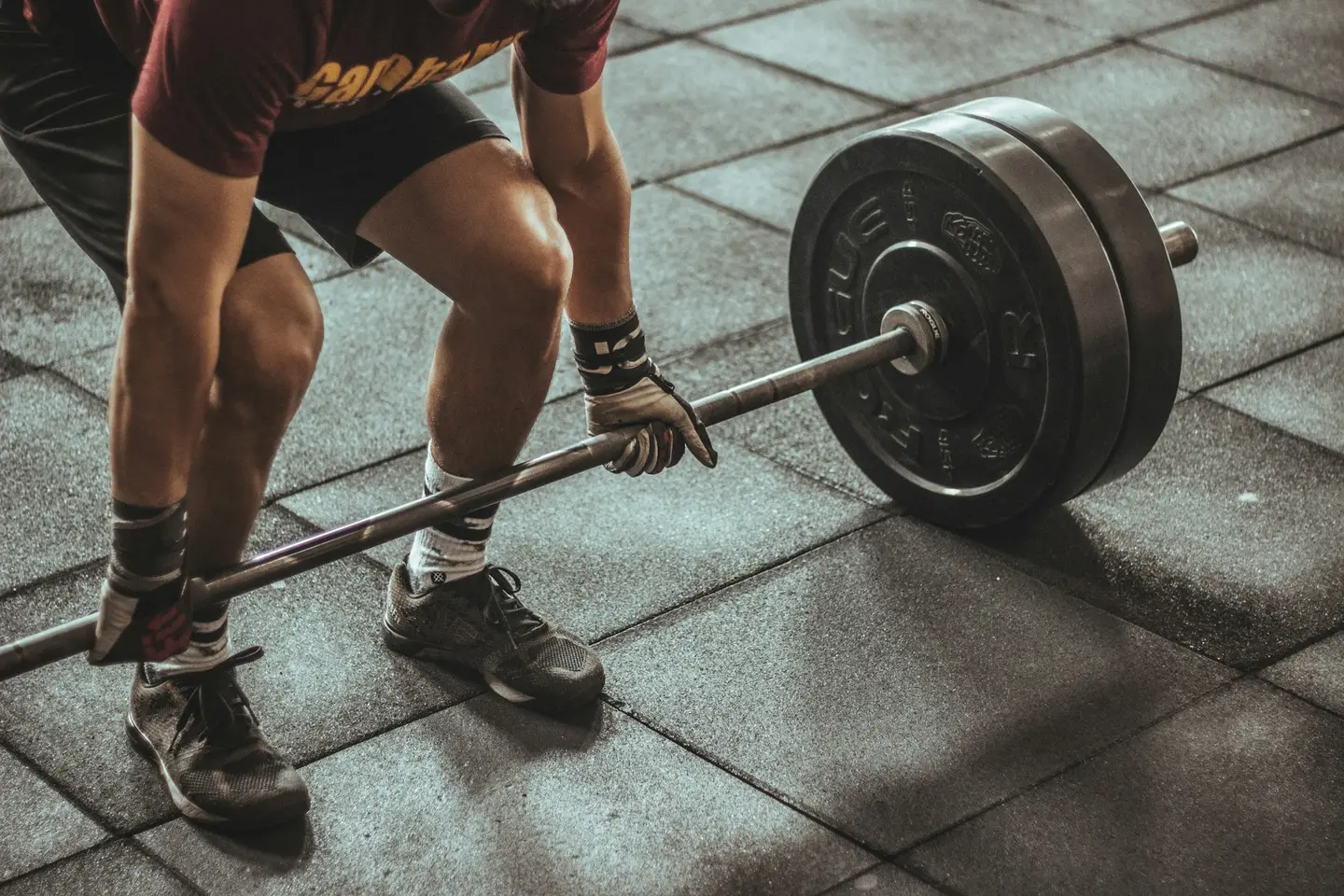
Three kinds of PR
Lifters use “PR” for three different records, and each one answers a different question.
A weight PR is the heaviest weight you have lifted on an exercise, for any number of reps. A rep PR is the most reps you have done with a given weight. Every weight has its own, so you can set one on a light day. An estimated one-rep max PR is the set that predicts the highest single rep. It is the only one of the three that compares sets done with different weights, and the one this guide is about.
Weight times reps is a fourth number some lifters track. It measures the work done, and says little about strength. 160 lb for 12 is 1,920 lb of volume, and 185 lb for 6 is only 1,110. The lighter set did more work at a lower intensity. It doesn’t say which set needed more strength.
How to compare two sets at different weights
Turn each set into the one-rep max it predicts, and compare those. The one-rep max calculator does it for any set, and explains the formulas. With Epley’s, weight × (1 + reps / 30):
| Set | Estimated one-rep max (Epley) |
|---|---|
| 185 lb × 6 (84 kg) | 222 lb (101 kg) |
| 170 lb × 9 (77 kg) | 221 lb (100 kg) |
| 160 lb × 12 (73 kg) | 224 lb (102 kg) |
| 160 lb × 13 | 229 lb (104 kg) |
By this formula, 170 for 9 falls just short of 185 for 6, 160 for 12 edges past it, and 160 for 13 beats it by 3 %. The formulas were built from sets taken to failure, so the comparison holds when both sets ended about as close to failure.
How big a difference counts?
The estimate is a number with an error around it, and two sets a few pounds apart sit inside that error. Three things decide how big a gap has to be before it means something.
The formulas disagree on close calls
There are at least seven common one-rep max formulas, and none has won every comparison. We ran the first pair of sets through all seven. Four of them (Epley, Lombardi, Mayhew and O’Connor) rate 185 × 6 stronger, and three (Brzycki, Lander and Wathen) rate 170 × 9 stronger. The verdicts range from 4.3 % in favor of the heavier set to 1.7 % in favor of the lighter one.
The further apart the rep counts, the more the formulas split. For 185 × 6 against 160 × 12, they range from 7 % in favor of one set to 7 % in favor of the other. Brzycki’s and Lander’s climb steeply as the reps go up, and Lombardi’s flattens. Comparing a set of 6 with a set of 12 asks the formula to be right about the shape of your whole strength curve between those two points.
Your reps change from week to week
Even with the same weight, you won’t get the same number of reps every time. In 24 resistance-trained men and women tested twice on the bench press a week apart, the typical difference in reps to failure was about 0.7 reps at 80 % and 90 % of their max, and 1.1 reps at 70 % (Mitter et al. 2022). Their tested one-rep max varied by under 2 %.
Our arithmetic from those numbers: around 6 to 12 reps, each rep is worth about 2.5 % of the Epley estimate, so 0.7 reps of day-to-day noise moves it by about 2 %. A new estimate that beats your old best by 1 % is within the noise. One that beats it by 5 % probably isn’t.
Some lifts fool the formulas
The classic test of seven formulas measured 67 untrained college students on the bench press, squat and deadlift, after four practice sessions. Each lifter tested a one-rep max and a set to failure with a weight they could lift 10 times or fewer (LeSuer et al. 1997).
All seven formulas tracked the real max closely across lifters (correlations of 0.95 to 0.99), but each lift had its own bias:
- On the bench press, the formulas were within about 6 % on average, and two (Mayhew’s and Wathen’s) were within 1 %
- On the squat, they underestimated by 2–8 %, and only Wathen’s was not significantly off
- On the deadlift, every formula underestimated, by 9–14 %
When you compare your own sets on one exercise, a bias that stays the same cancels out. Two deadlift sets that are both read 10 % low still rank correctly. The trouble comes when the bias changes with the reps, and it does on long sets. In 70 adults, a one-rep max predicted from a 5-rep max was more accurate than one from a 10 or 20-rep max (Reynolds et al. 2006). In 103 college women, most formulas were within about 4 % on average with 10 reps or fewer, but missed by much more on longer sets (Mayhew et al. 2008). And the number of reps people manage at a given percentage of their max varies by exercise and by person: at 80 %, about 9 reps on the bench press and 13 on the leg press, with a spread of 2.5 reps between individuals (Nuzzo et al. 2024).
Compare like with like
These are our suggestions, built from the studies above:
- Compare sets of the same exercise, with the same setup and range of motion. A deeper squat or a paused bench press is a different test.
- Compare sets that ended about as close to failure. A set stopped with 3 reps left predicts less than you could lift. If you track reps in reserve, add them to the reps before you compare (see RIR and RPE).
- Compare sets of about 12 reps or fewer. Past that, the formulas drift apart and the estimate says less.
- Expect first sets to win. Later sets of an exercise start fatigued, so a lower estimate on set three doesn’t mean you got weaker.
- Treat a gap of 2–3 % or less as a tie, and look at the trend over weeks instead.
- On bodyweight exercises such as push-ups and pull-ups, compare reps. On weighted ones, count your bodyweight in the weight, or a set with 10 lb added and one with none won’t compare fairly.
How Workout Wizard does it
Workout Wizard marks a set as a record when its estimated one-rep max, by the Epley formula, beats every earlier set of that exercise. The set shows a PR medal as you log it, and the recap at the end of the workout lists each record with its estimate.
A few rules follow from the research above:
- A tie isn’t a record. A set needs a higher estimate than every earlier one.
- Bodyweight exercises compare reps. Weighted and assisted ones, such as a pull-up with a plate or on an assisted machine, count the day’s bodyweight plus the plate or minus the assistance, and use that same bodyweight for every earlier set. A change in bodyweight doesn’t create a record.
- The first time you do an exercise has no records, because every set would be one.
- A set needs at least one rep to be logged at all.
The app counts the reps you logged, without adding reps in reserve, so it reads every set as if it ended near failure.
So, was it a PR?
It was a rep PR if you never did that many reps with that weight. It was a stronger set only if its estimated one-rep max beats your best by more than the noise, a few percent. 170 for 9 after 185 for 6 is a tie, and 160 for 13 after 185 for 6 is a real step up.
References
- LeSuer DA, McCormick JH, Mayhew JL, Wasserstein RL, Arnold MD. 1997. The accuracy of prediction equations for estimating 1-RM performance in the bench press, squat, and deadlift. J Strength Cond Res 11(4):211–213. doi:10.1519/00124278-199711000-00001. Not in PubMed.
- Mayhew JL, Johnson BD, LaMonte MJ, Lauber D, Kemmler W. 2008. Accuracy of prediction equations for determining one repetition maximum bench press in women before and after resistance training. J Strength Cond Res 22(5):1570–1577. doi:10.1519/JSC.0b013e31817b02ad. PMID 18714230.
- Mitter B, Csapo R, Bauer P, Tschan H, Gruet M. 2022. Reproducibility of strength performance and strength-endurance profiles: a test-retest study. PLoS One 17(5):e0268074. doi:10.1371/journal.pone.0268074. PMID 35511896.
- Nuzzo JL et al. 2024. Maximal number of repetitions at percentages of the one repetition maximum: a meta-regression and moderator analysis of sex, age, training status, and exercise. Sports Med 54(2):303–321. doi:10.1007/s40279-023-01937-7. PMID 37792272.
- Reynolds JM, Gordon TJ, Robergs RA. 2006. Prediction of one repetition maximum strength from multiple repetition maximum testing and anthropometry. J Strength Cond Res 20(3):584–592. doi:10.1519/R-15304.1. PMID 16937972.